Industry as the First Customer: How Tamil Nadu Builds Deep Tech
Tamil Nadu went from 2,032 registered startups in 2021 to more than 12,050. The number is not the interesting part — the structure that produced it is.
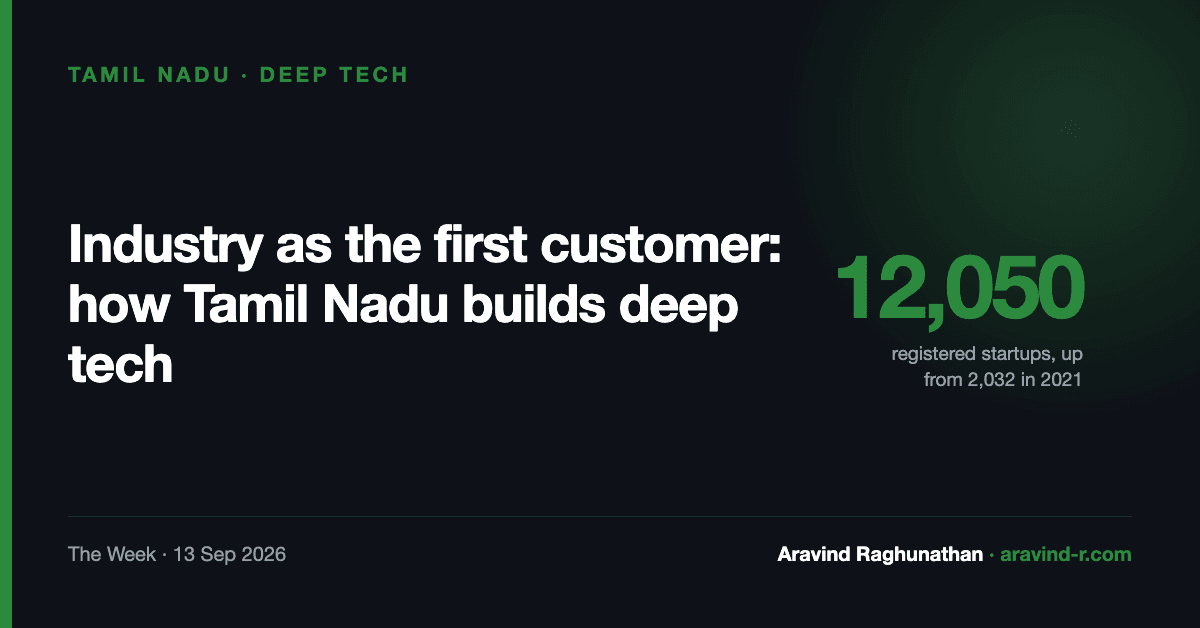
Tamil Nadu had 2,032 registered startups in 2021. It now has more than 12,050. Over the same five years the state's startup mission, StartupTN, reports generating more than $27.4 billion, and Chennai has moved into Asia's top twenty startup hubs at number 18.
Those numbers come from a piece The Week ran this weekend on how the state's ecosystem is built. The numbers are not the interesting part. The structure underneath them is.
Industry as the first customer
Dr Tamaswati Ghosh, who runs the IIT Madras Incubation Cell, makes the argument plainly: Tamil Nadu's industrial base gave its deep-tech startups access to a market.
These were not conventional software companies. They were hardware, engineering and science businesses with real intellectual property and long development cycles — the kind that usually die in the gap between a working prototype and a paying customer. In Tamil Nadu the automobile and manufacturing companies down the road became mentors, then first customers, then strategic investors.
Her counterfactual is the sharp bit. Build the same incubation programme somewhere without that industrial access, she argues, and you do not get the same result.
That inverts the usual model. The standard playbook treats industry as an eventual buyer, reached after product-market fit. Here industry is what produces product-market fit, because a manufacturer who has run a process for thirty years can tell you in a week whether your technology survives contact with a factory floor.
Where the state is putting money
R. Kumar, the state's minister for AI, IT and digital services, announced a Vetri Tamil Nadu Deep-Tech Innovation Fund, to be set up through the Tamil Nadu Technology Hub with an initial corpus of Rs 50 crore. The stated targets are AI and machine learning, large and small language models, advanced materials, semiconductors and robotics, aimed at startups, researchers and PhD scholars.
Rs 50 crore is a small number for that list. Roughly one Series A. Read as a venture fund it does not move much. Read as early, patient capital for research with no other route to money, it might. Which one it turns out to be depends on cheque size and stage discipline, and neither has been published.
There is a longer-running example of the same instinct. TIDCO put Rs 25 crore into Agnikul Cosmos, based at the IIT Madras Research Park, which is building Agnibaan — a 3D-printed launch vehicle, aiming at a fully recoverable small satellite launcher. Agnikul said this week that satellite firms are lining up for dedicated launches.
Ghosh's description of that lineage is the best line in the piece: the state moved from making car parts to 3D-printing the future of space travel.
What this does and does not prove
Ather, Uniphore, ePlane and Agnikul all trace back through the same IIT Madras orbit. That is a genuine cluster, and clusters are hard to manufacture on purpose — which is why the ones that exist are worth studying.
What the numbers do not show is depth. Twelve thousand registered startups is a registration count, not a survival count. $27.4 billion generated is an ecosystem-wide figure that needs unpacking before it means much. And the med-tech thesis that G.S.K. Velu of Neuberg and Trivitron argues for — India pivoting from service provider to machine builder, with the next decade in Tamil Nadu belonging to medical devices — is a prediction, not a result.
The state is holding to a $1.5 trillion economy target with GSDP growth reported at 16 per cent, and the May 2026 change of government has not altered the direction.
For anyone running technology in India the practical question is narrower than any of that. If you need hardware-adjacent AI built, tested against a real production process, and taken to manufacture, the number of places in the country that can do all three is small. Tamil Nadu is one of them.
Source: How Tamil Nadu's startup ecosystem is powering the future of deep-tech — The Week