Microsoft's Fourth India Cloud Region Is Really About Context, Not Capacity
Microsoft has opened its India South Central cloud region in Hyderabad. The numbers around the launch say more about where enterprise AI in India is heading than the region itself.
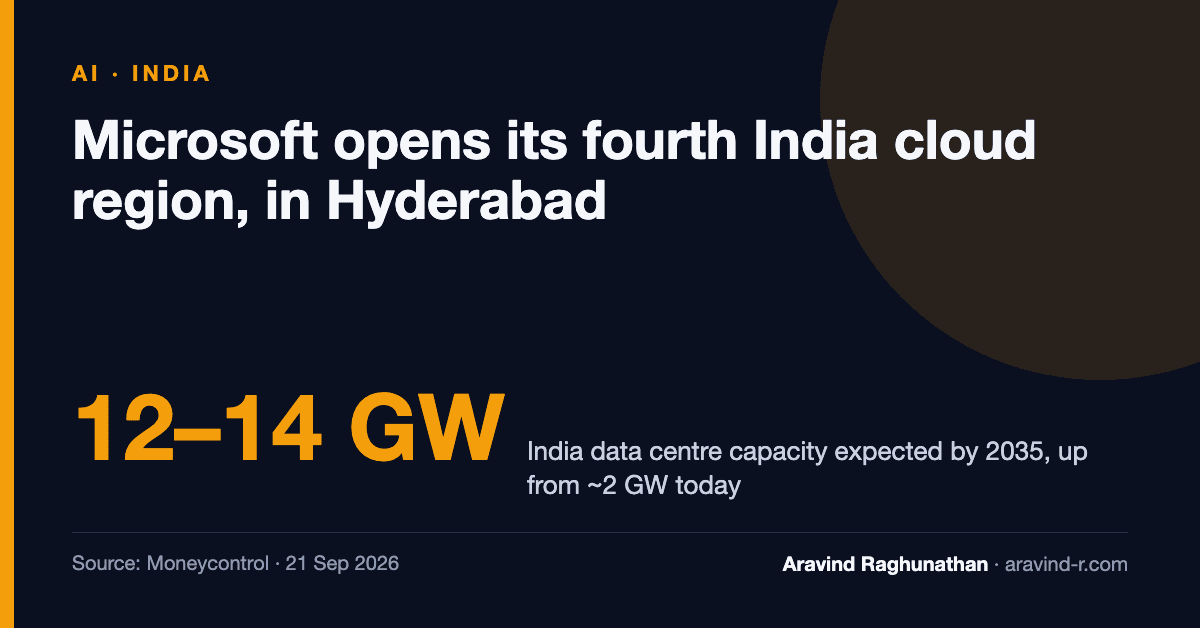
Microsoft switched on its fourth cloud region in India on 21 September. The new India South Central region is in Hyderabad, and it joins Pune, Chennai and Mumbai. Puneet Chandok, president of Microsoft India and South Asia, called it the largest hyperscale cloud footprint in the country.
A new region on its own is routine news. What made this launch worth reading were the numbers Chandok attached to it.
The gap Microsoft is pointing at
His framing: India generates about 20% of the world's data but hosts only about 3% of its data centre capacity. The country sits at roughly 2 GW of capacity today, and he expects 12 to 14 GW by 2035.
He also cited more than $100 billion of private capital committed to India's data centre build-out, and $1.3 billion approved by the government for the IndiaAI Mission. On demand, he didn't hedge. Demand isn't the issue, he said; supply is.
The Hyderabad region comes out of Microsoft's $20.5 billion India commitment, which combines an earlier $3 billion with the $17.5 billion announced in December 2025. That money covers cloud and AI infrastructure, skilling and operations.
From digital public infrastructure to AI public infrastructure
Chandok described the build-out as the physical base for India moving from digital public infrastructure to what he called "AI public infrastructure". He compared it to the Green Revolution: models are the new seed, while compute and skilling are the irrigation canals.
He pointed to the IndiaAI Mission's shared layer as evidence that this is already under way: 45,000 GPUs, more than 14,000 datasets and over 300 models.
Adoption is running ahead of capacity
The adoption figures he quoted come from Microsoft's own Work Trend Index:
- 92% of Indian knowledge workers use AI, against 75% globally
- 40% of Indian enterprises are scaling AI deployments
- Agent usage in Microsoft 365 is up 15-fold
- About half of the work done in Copilot involves reasoning and decision-making
These are Microsoft's own numbers, so I'd read them as a direction of travel rather than an audited figure. The direction is hard to argue with, though: work is moving from pilots to production, and from chat to agents that act.
Why this matters for enterprise AI leaders
The line from the launch I keep coming back to is "The model is not your moat. Your context is." Models keep getting cheaper and more interchangeable. What stays scarce is an organisation's own data, processes and institutional knowledge, and where that context lives.
This is where in-country capacity starts to matter. When agents start acting on enterprise data, residency, latency and regulatory trust stop being procurement checkboxes and become design constraints. A fourth region gives Indian enterprises more room to keep that context close, with redundancy across four locations instead of three.
Microsoft is pairing the infrastructure with skilling. It is targeting 20 million Indians for AI skills by 2030, including two million teachers, and says more than 10 million have already been trained.
For CIOs, capacity is becoming less of a constraint. Whether their data, governance and teams are ready to use it is a separate question, and a harder one.
Source: Microsoft launches fourth India cloud region, expands AI infrastructure footprint — Moneycontrol