India's Fintechs Use AI Everywhere Except Where the Money Moves
At the Global Fintech Fest, Indian fintech executives described AI running fraud checks and support queues in production — while every attempt to let software actually spend a customer's money stays in pilot.
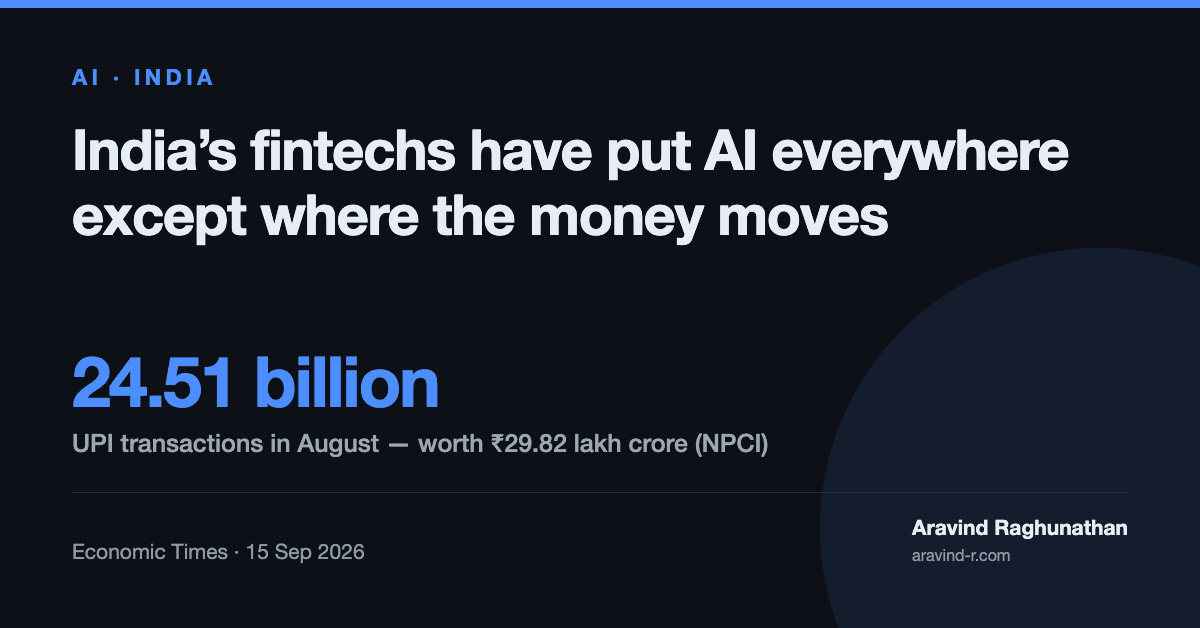
Indian fintech firms have pushed AI well past the chatbot stage. What they have not done, and are in no hurry to do, is let it spend anyone's money.
Executives told the Economic Times as much on the sidelines of the Global Fintech Fest last week. AI is running in production across fraud detection, customer service and tightly scoped internal workflows. Agentic commerce — software initiating a payment on a customer's behalf — is still in pilot.
The rails are too big to experiment on
UPI processed 24.51 billion transactions in August, worth Rs 29.82 lakh crore, according to NPCI data. That is the substrate any agentic payment layer would have to sit on.
A system at that volume does not get to fail gracefully. When a fraud model misfires, you get a false positive and an irritated customer. When an agent misfires, money leaves an account. Indian fintechs are treating those as different problems, which they are.
What has to exist before an agent can pay
The executives were specific about what is missing. Four things need to be in place before software can be trusted to transact:
- Verifiable customer mandates — a durable, checkable record that the customer authorised this class of spending
- Links across banks and merchants, so the mandate means the same thing on both sides of a transaction
- Spending limits that live outside the model's judgment
- Audit trails, so a dispute has something factual to resolve against
None of that is a model capability. It is plumbing, and it is the kind of plumbing that requires regulators, banks and merchants to agree with each other first.
The constraint is not the model
Most serious enterprise AI adoption I see is running into the same wall. The model is rarely the bottleneck. The accountability layer around it is — who authorised the action, what bounded it, and what record survives to settle the argument afterwards.
Fintech is where the gap shows up most clearly, because there the cost of an unbounded action is denominated in rupees and lands on someone's statement.
Source: Fintechs high on AI, but yet to let it handle your money